Overview
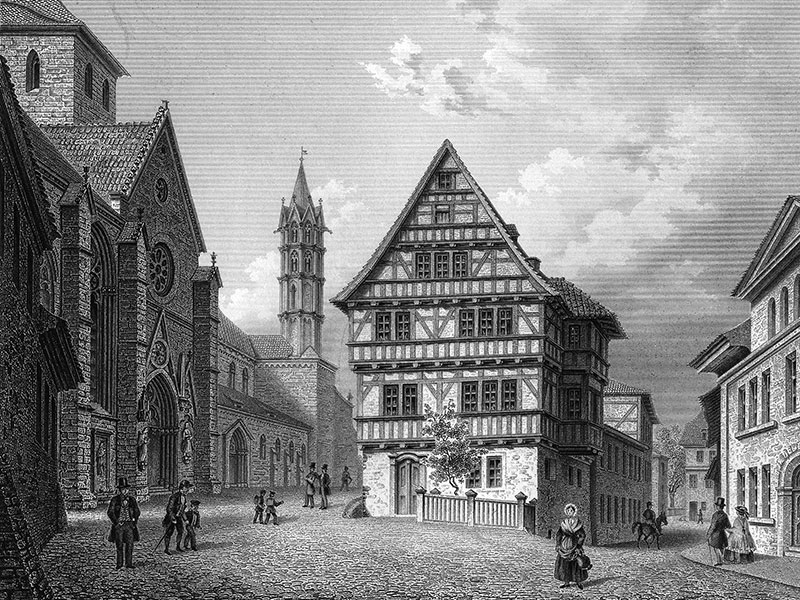
Sachsen-Anhalt and Thuringia, the Länder in the middle of Germany, are predominantly rural, with rolling hills, deciduous woodland, compact red-roofed villages and ancient small-scale cities. Only patchily affected by the ravages of war and industrialisation, much of the historic architecture remained intact throughout the 20th century. 40 years in the chill embrace of the East German state further impeded ‘progress’. The result is that at the heart of Europe’s richest and most modern nation is a region which feels strangely provincial and archaic.
Thuringia was one of the five major states of early medieval Germany, but by the end of the Middle Ages it had fragmented into numerous little statelets and free cities. The history of Sachsen-Anhalt was similar: during the tenth century ‘Old’ Saxony was the most powerful of the German duchies and formed the kernel of the German nation, but loss of pre-eminence was followed by subdivision. From the 16th century both Länder consisted of innumerable principalities and independent cities, and were political and economic backwaters – though in the 17th and 18th centuries the Bach family dominated music making here.
And one small dukedom in particular made a quite exceptional contribution to art and thought. Weimar played host to J.S. Bach, Goethe, Schiller, Herder, Liszt, Nietzsche, Richard Strauss, Walter Gropius and many other great names.
For those who knew East Germany before 1991, the subsequent changes appear little short of miraculous – major upgrading of the infrastructure, transformation of the built environment through cleaning, painting and wholesale restoration, recrudescence of commercial and social life. But those who come to the territory for the first time might be less enamoured. It is as if the region hasn’t fully awoken from a half-century sleep, a corrosive slumber which allowed much of the historic fabric of the towns and villages to slide into desuetude and dereliction.
Yet in an odd sort of way the dilapidation contributes to a powerful sense of the past, and an air of authenticity which can be lost in places more thoroughly spruced up emanates from this fascinating, constantly surprising, frequently beautiful and richly-endowed region.
Day 1
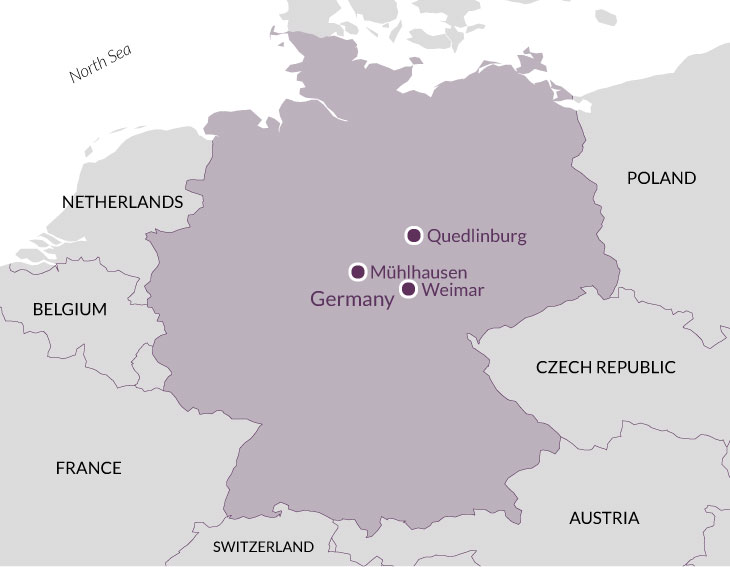
London to Quedlinburg. Fly at c. 9.45am from London Heathrow to Berlin (British Airways). Drive to Quedlinburg. First of three nights in Quedlinburg.
Day 2
Quedlinburg, Gernrode. Quedlinburg is a wonderfully preserved medieval town. The castle hill is crowned by the church of St Servatius, begun 1070, and contains one of Germany’s finest treasuries. See also the Gothic church of St Benedict in the market square and the Wipertikirche with its tenth century crypt. At nearby Gernrode is one of the oldest churches in Germany, and one of the most beautiful, St Cyriakus, begun ad 961. Overnight Quedlinburg.
Day 3
Blankenburg, Halberstadt. Blankenburg is an idyllic little spa town in the foothills of the Harz mountains with two Baroque palaces, the creation of a younger son of the Braunschweig-Wolfenbüttel dynasty who made Blankenburg his capital. Halberstadt was a major city in the Middle Ages, and the cathedral is the largest French-style Gothic church in Germany after Cologne; the treasury is exceptional. Overnight Quedlinburg.
Day 4
Mühlhausen. Drive in the morning across the Harz mountains to Thuringia, passing forested vistas, half-timbered hamlets and patches of pasturage. Mühlhausen is astonishing, one of the most delightful and evocative towns in northern Europe, preserving its complete medieval wall, an abundance of half-timbered buildings and six Gothic churches. Walk along a section of the wall, visit the soaring, five-aisled church of St Mary, and St Blasius, the church where Bach was organist 1707–08. Overnight Mühlhausen.
Day 5
Gotha, Arnstadt. A Residenzstadt within the principality of Saxe-Coburg-Gotha, Gotha is dominated by Schloss Friedenstein, which has fine interiors, a picture collection and a Baroque theatre. Walk down a processional way to the Hauptmarkt with its Renaissance town hall. Arnstadt, the oldest town in eastern Germany, has fine streetscape on a sloping site with the church where Bach was organist 1703–7; the Early Gothic Church of Our Lady and a palace which illustrates social hierarchy from the court’s perspective. First of four nights in Weimar.
Day 6
Weimar. Two centuries of enlightened patronage by members of the ducal family enabled the little city-state of Weimar to be home to many great writers, philosophers, composers and artists. Today, visit the Stadtkirche, the main church with an altarpiece by Cranach, Goethe’s house, a beautifully preserved sequence of interiors and garden, the ducal Schloss, with Neo-Classical interiors and a fine art museum, and an English-style landscaped park with Goethe’s summer house. Overnight Weimar.
Day 7
Erfurt. Capital of Thuringia, Erfurt well preserves its pre-20th-century appearance with a variety of streetscape and architecture from medieval to Jugendstil. Outstanding are the Krämerbrücke, a 14th-century bridge piled with houses and shops, and the cathedral, framing Germany’s largest set of medieval stained glass. See also the Severikirche, the friary of St Augustine where Luther was a monk, the Predigerkirche which retains its late medieval appearance intact, and the 17th-century hilltop citadel. Overnight Weimar.
Day 8
Weimar. A walk includes Haus am Horn and Van de Velde’s School of Arts and Crafts from which the Bauhaus emerged. Free afternoon in this beautiful little city. Among the many other museums to choose from are the Bauhaus Museum, the 18th-century Wittumspalais and the Schiller House. An excursion to Buchenwald concentration camp can be arranged. Overnight Weimar.
Day 9
Naumburg. Architecturally, Naumburg Cathedral is an outstanding embodiment of the transition from Romanesque to Gothic, but its great importance lies in its 13th-century sculpture, including statues of the founders, among the most powerful and realistic of the Middle Ages. Fly from Berlin, arriving Heathrow at c. 8.45pm.

Dr Jarl Kremeier
Art historian specialising in 17th- to 19th-century architecture and decorative arts; teaches Art History at the Berlin College of Acting and the Senior Student’s Department of Berlin’s Freie Universität. He studied at the Universities of Würzburg, Berlin and the Courtauld, is a contributor to the Macmillan Dictionary of Art, author of a book on the Würzburg Residenz, and of articles on Continental Baroque architecture and architectural theory.
Price, per person
Two sharing: £3,870 or £3,500 without flights. Single occupancy: £4,280 or £3,910 without flights.
Included
Air travel (Euro Traveller) on scheduled British Airways flights (aircraft: Airbus 320); travel by private coach; hotel accommodation as described below; breakfasts, 2 lunches and 5 dinners with wine; all admissions to museums and sites; all gratuities for restaurant staff, drivers, guides; all airport and state taxes; the services of the lecturer.
Accommodation
Romantik Hotel am Brühl, Quedlinburg: restored 4-star hotel in a heritage building near the historical heart, comfortably furnished. Brauhaus “Zum Löwen”, Mühlhausen: 3-star converted brewery in the centre of the town; characterfully rustic dining area and bar, simple but spacious rooms. Dorint Am Goethepark, Weimar: a modern 4-star hotel, situated by the park and on the edge of the town centre. Single rooms throughout are doubles for sole use.
There are no twin rooms at the Romantik Hotel am Brühl in Quedlinburg. Contact us for a supplement to book two rooms at this hotel if you require two beds.
How strenuous?
This tour is fairly long and there is quite a lot of walking in the town centres where vehicular access is restricted. It should not be attempted by anyone who has difficulty with everyday walking and stair-climbing. Average distance by coach per day: 56 miles. There are long transfers between each hotel and the airport, otherwise coach travel is limited to short excursions.
Are you fit enough to join the tour?
Group size
Between 10 and 22 participants.
Travel advice
Before booking, please refer to the FCDO website to ensure you are happy with the travel advice for the destination(s) you are visiting.
Combine with
In 2025:
Cave Art of France, 3–10 September
Samarkand & Silk Road Cities, 4–16 September
Frank Lloyd Wright, 5–15 September
'It is impossible to praise our lecturer too much. He effortlessly combined the organisational aspect of the tour with cultural enlightenment.'
'Thank you for all your attention to detail. It is good to know that all eventualities have been foreseen.'
'The first experience with Martin Randall was so good it did not occur to us to look elsewhere.'