
Europe
(172)
Italy
(59)
France
(21)
Germany
(21)
United Kingdom
(17)
Spain
(16)
Austria
(8)
Czech Republic
(6)
Greece
(5)
Portugal
(4)
Switzerland
(4)
Finland
(3)
Netherlands
(3)
Belgium
(2)
Malta
(2)
Slovakia
(2)
Albania
(1)
Bulgaria
(1)
Croatia
(1)
Cyprus
(1)
Denmark
(1)
Hungary
(1)
Ireland
(1)
Norway
(1)
Poland
(1)
Romania
(1)
Slovenia
(1)
Sweden
(1)
    Array
(
    [0] => Array
        (
            [name] => Spain
            [category] => Array
                (
                    [name] => Country
                )

            [parent] => Array
                (
                    [name] => Europe
                )

        )

    [1] => Array
        (
            [name] => Asturias
            [category] => Array
                (
                    [name] => Location
                )

            [parent] => Array
                (
                    [name] => Spain
                )

        )

)


Early Spain: Asturias & Cantabria - history and architecture of the green north
7
days
from
A$5,730
Book today with a deposit from
A$860
8th - 14th July 2027
Tour highlights
- Green Spain’s remote valleys sheltered Iberia’s last unconquered Christian kingdom from the Moors.
- Asturian pre-Romanesque – a beguiling style unique to this region – peaks in Oviedo’s ninth-century churches.
- Overnights in Oviedo’s atmospheric old quarter and the perfectly preserved village of Santillana del Mar.
- Gaudí’s exuberant Capricho villa and Cervatos’s carved corbels broaden the range beyond pre-Romanesque.
- Dr Hugh Doherty, a medieval historian specialising in the period 700–1200, leads throughout.
This tour takes us off the tourist map into the heart of Green Spain, where the survival of an independent Christian kingdom shaped the whole of Spanish history.
In the Middle Ages, Asturias and Cantabria became the improbable last redoubt of Christian Iberia. At Covadonga, a cave shrine perched above a waterfall marks the spot where the Asturians rose against the Moors in the eighth century, beginning the Reconquista – and Asturians still proudly maintain that ‘Asturias is Spain; the rest is conquered territory.’ Iberian Christians fled here from Muslim rule in the south, carrying with them, so it’s claimed, the largest surviving piece of the True Cross, now held in the Monastery of Santo Toribio at the end of the dramatic La Hermida gorge.
It’s this kingdom-building – kings consolidating power against a hostile frontier – that produced Asturian pre-Romanesque, an architectural style unique to this corner of Spain and found nowhere else. The ninth century saw a proliferation of these churches as the reconquest gathered pace: the royal palace and church on the slopes of Mount Naranco, and Santullano, the largest Christian building in Spain until the 11th century, its murals still largely intact. Later medieval work, particularly in Oviedo, and the 19th-century return of the indianos – Asturians who made fortunes in the Americas and spent them on fantasy modernist villas, none more striking than Gaudí’s Capricho at Comillas – complete the region’s architectural range.
Itinerary
Fly at c. 9.30am from London Gatwick to Bilbao (Vueling). Drive to Oviedo, arriving late afternoon. First of two nights in Oviedo.
Morning visits to pre-Romanesque churches in and around Oviedo. Santullano is richly decorated with well-preserved mural paintings. Overlooking the city on the slopes of Mount Naranco sit San Miguel de Lillo and the hauntingly beautiful palace-cum-church of Santa María, built by King Ramiro I (842–850), the greatest artistic patron in the history of Asturias. The Archaeological Museum houses artefacts rescued from Naranco and other sites to be visited throughout the week. End at the Gothic cathedral, with tombs of the early Asturian kings, and the adjoining Cámara Santa, the original pre-Romanesque church of King Alfonso II the Chaste (791–842) with fine sculpture.
Santa Cristina is a jewel of Asturian pre-Romanesque, perched above the Lena valley, with a rare ninth-century iconostasis intact. Drive eastward, stopping at San Salvador de Valdedios, nestled at the foot of a lush valley and built for Alfonso III as part of a palace complex in the ninth century. San Salvador de Priesca is one of the latest Asturian pre-Romanesque churches with mozarabic influences. Overnight in Cangas de Onís.
The shrine of Covadonga marks the spot where the Asturians repelled the Moors in 718, the cradle of the reconquista. Stop for lunch in San Vicente de la Barquera, a traditional fishing port dominated by a fortress-like church. The Capricho in Comillas is the most notable of the region’s 19th-century modernist villas and one of Gaudí’s lesser-visited works, commissioned by a Cantabrian who made his fortune in the Americas. Continue to Santillana del Mar for the first of three nights.
Ascend into the hills in the south of Cantabria, near the source of the Ebro. Argüeso Castle was a formidable Mendoza stronghold crowning the hills of Campoo, its towers commanding sweeping valley views. The collegiate church of San Pedro de Cervatos is famed for its richly carved corbels, among the most celebrated sculptural ensembles in Cantabria. The beautifully preserved Romanesque church of San Martín sits above the Ebro canyon, with exquisitely carved capitals and a cloister of medieval tombs.
Drive (c. 1 hour 45 minutes each way) through the dramatic scenery of La Hermida gorge, ascending towards the soaring Picos de Europa mountain range. En route visit the remote and striking mozarabic church of Santa María de Lebeña, before arriving at the Monastery of Santo Toribio, with a chapel holding the largest piece of the True Cross. Lunch break in the picturesque town of Potes before returning to Santillana for a little free time.
Return to Bilbao via the harbour town of Castro Urdiales, crowned by the Gothic church of Santa María, its French-influenced towers and buttresses rising beside a medieval castle turned lighthouse. Some free time for lunch in Bilbao’s medieval old town, then fly from Bilbao to London Gatwick, arriving c. 6.30pm.
Expert speaker
Dr Hugh Doherty
A specialist in the history of the British Isles and continental Europe from Charlemagne to Innocent III, Hugh Doherty is Lecturer in Medieval History at the University of East Anglia. He was taught at King's College London, Cambridge and Oxford, and held a research fellowship at Jesus College, Oxford, before turning to the records and ambitions of early medieval kings and their secular élites. He holds that architecture, material culture and landscape matter as much as the written page – a conviction that has occasionally taken him from the archive to the film set, advising HBO and Netflix on medieval life.
More tours led by Dr Hugh Doherty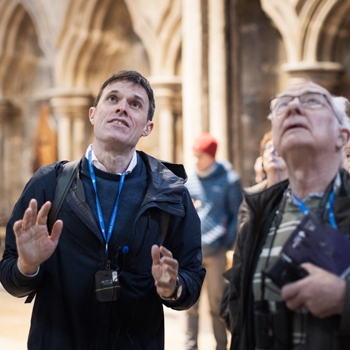
Practicalities
Price, per person. Two sharing: A$6,270 or A$5,730 without flights. Single occupancy: A$7,380 or A$6,840 without flights.
Travel by private coach throughout; hotel accommodation as described below; breakfasts and five dinners with wine, water and coffee; all admissions; all tips; all taxes; the services of the lecturer and tour manager.
Eurostars Hotel de la Reconquista, Oviedo: 5-star hotel in a converted 17th-century hospice. Parador de Cangas de Onís: 4-star hotel in a rural setting; converted 12th-century monastery with modern extension. Parador de Santillana Gil Blas, Santillana del Mar: 4-star Parador, traditionally furnished. Single rooms are doubles for sole use throughout.
There is a lot of walking in town centres and to access some churches, often on cobbled streets, rough paths and up steep gradients. Sure-footedness and a good level of fitness are necessary. It should not be attempted by anyone who has difficulty with everyday walking and stair-climbing. There are some long drives. Average distance by coach per day: 103 miles.
Typically between 10 and 24 participants.
Before booking, please refer to Smartraveller to ensure you are happy with the travel advice for the destination(s) you are visiting. As a British company we follow the advice of the UK Foreign Commonwealth and Development Office.
Dates & prices
                AUD                Array
(
    [0] => Array
        (
            [id] => 01m11jaszpdk5t4e35c0zqr0hn
            [published] => 1
            [start] => 2027-07-08 00:00:00
            [end] => 2027-07-14 00:00:00
            [range_type] => Fixed
            [version] => Array
                (
                    [id] => 01m11fgasw6hwrha6em7j9vbbr
                    [name] => 2027
                )

            [inventory] => Array
                (
                    [type] => Allocation
                    [capacity] => 18
                    [errata] =>
                )

            [categories] => Array
                (
                    [0] => Array
                        (
                            [name] => Dr Hugh Doherty
                            [description] =>
                        )

                )

            [fields] => Array
                (
                    [0] => Array
                        (
                            [__typename] => StringFieldData
                            [name] => tb_departure_setup_id
                            [string] => 31062
                        )

                    [1] => Array
                        (
                            [__typename] => StringFieldData
                            [name] => tb_link_speakers
                            [string] => [{"id":118632,"title":"Dr","forename":"Hugh","surname":"Doherty","type":"Lecturer"}]
                        )

                    [2] => Array
                        (
                            [__typename] => StringFieldData
                            [name] => tb_departure_code
                            [string] => MN427
                        )

                    [3] => Array
                        (
                            [__typename] => StringFieldData
                            [name] => onlinetalk_booking_link
                            [string] =>
                        )

                )

            [elements] => Array
                (
                    [0] => Array
                        (
                            [id] => 01m11jat184av9w7fyc6s10nm6
                            [element] => Array
                                (
                                    [id] => 01m11jascejnbfdh9y3fpy688y
                                    [category] => Array
                                        (
                                            [name] => Tour Space
                                        )

                                    [name] => Tour Space
                                    [published] => 1
                                    [is_package] => 1
                                )

                            [prices] => Array
                                (
                                    [0] => Array
                                        (
                                            [id] => 01m11jat2c80vwve0yknx9wxhw
                                            [currency] => AUD
                                            [value] => 5730
                                            [on_sale] => 1
                                            [previous_value] =>
                                            [deposit] =>
                                            [option] => Array
                                                (
                                                    [id] => 01m11jasebek9maqrvv68k7j8d
                                                    [name] => Tour Space
                                                    [category] => Array
                                                        (
                                                            [name] => Price
                                                        )

                                                    [constraints] =>
                                                    [web_bookable] => 1
                                                    [published] => 1
                                                )

                                        )

                                )

                        )

                    [1] => Array
                        (
                            [id] => 01m11jat2rmq7k1gmbgr3rhsj7
                            [element] => Array
                                (
                                    [id] => 01m11jasgqcemsqdgew03t1a5y
                                    [category] => Array
                                        (
                                            [name] => Flights
                                        )

                                    [name] => Flight
                                    [published] => 1
                                    [is_package] => 1
                                )

                            [prices] => Array
                                (
                                    [0] => Array
                                        (
                                            [id] => 01m11jat3tb9dfw987c2z36tfd
                                            [currency] => AUD
                                            [value] => 1620
                                            [on_sale] => 1
                                            [previous_value] =>
                                            [deposit] =>
                                            [option] => Array
                                                (
                                                    [id] => 01m11jaskdgctj1be6y2wqj1ja
                                                    [name] => Price
                                                    [category] => Array
                                                        (
                                                            [name] => Price
                                                        )

                                                    [constraints] =>
                                                    [web_bookable] => 1
                                                    [published] => 1
                                                )

                                        )

                                )

                        )

                )

        )

)
2027
Date
Speaker
Price
Date:
8th - 14th July 2027
Speaker:
Dr Hugh Doherty
Price:
from A$5,730
(Based on two sharing)Related tours and events


Sign up to our e-newsletter
e-newsletter recipients are the first to hear about our future plans and our tours as they come on sale. By signing up you agree to our Privacy policy.




My Wishlist
Please note that all saved tours will be removed if you clear your cookies.
Sign up to our e-newsletter
E-newsletter recipients are the first to hear about our future plans and our tours as they come on sale.