
Europe
(171)
Italy
(58)
France
(21)
Germany
(21)
United Kingdom
(17)
Spain
(16)
Austria
(8)
Czech Republic
(6)
Greece
(5)
Portugal
(4)
Switzerland
(4)
Finland
(3)
Netherlands
(3)
Belgium
(2)
Malta
(2)
Slovakia
(2)
Albania
(1)
Bulgaria
(1)
Croatia
(1)
Cyprus
(1)
Denmark
(1)
Hungary
(1)
Ireland
(1)
Norway
(1)
Poland
(1)
Romania
(1)
Slovenia
(1)
Sweden
(1)
The World The Bauhaus made
03 Sep 2026
Berlin-based Tom Abbott is one of MRT’s most sought-after lecturers, with a range of architectural and historical knowledge spanning the 17th to 20th centuries, Germany, Italy and the US. Here he talks to Charlotte Crow about his two German modern architecture tours and why, after more than two decades, the buildings still inspire him.
Your portfolio spans Baroque Germany, Frank Lloyd Wright, King Ludwig II – and now the modern. Is there a thread that connects it all?
The thread is always the same question: what am I seeing, and why? What does this building, this object, this space tell us about the people who made it and the world they inhabited? That question works whether you are standing in a Rococo church in Bavaria or a Bauhaus workshop in Dessau.
I came to Germany before the Wall fell. I was working in something entirely different, but I was watching everything that was happening around me – one of the most extraordinary moments in modern European history. That experience of witnessing a country remake itself stayed with me. Eventually I went to university in Berlin to study architectural and art history formally, but the curiosity came first. It always does.
Let’s focus on the Bauhaus. It’s often described as an architectural movement, but you resist that framing.
People look at a building and say, that’s Bauhaus. But the Bauhaus was primarily a school of art and design – architecture came later, and only partially. What Walter Gropius founded in Weimar in 1919 had a far more ambitious intention: to design a new way of living, and through that, a new way of being.
These ideas don’t shock us today the way they shocked people in the 1920s – precisely because the Bauhaus succeeded. We sit on chairs whose beauty lies entirely in proportion and material, with no decorative elements. We work in offices designed to promote focus and harmony. More ventilation in buildings is a direct result of Bauhaus thinking. This is not abstract history; it is the texture of daily life.

William Cecil Lord Burghley, engraving 1832 by H.T. Ryall (1811–67)

Olympiapark München © Framalicious
How do you bring that to life on your Bauhaus tour?
We begin with objects. In Weimar, at the new Bauhaus Museum, we start with a chess set: made of unvarnished wood, each piece composed of three geometric forms – a sphere, a cone, a cube. From that single object you begin to understand how the Bauhaus was renewing our spatial memory, our relationship to geometry, to form. Then we move to the weavings. Weaving was central to the Bauhaus in a way people don’t always expect. Unlike embroidery, which is flat and courtly, weaving has relief and material presence. In a Bauhaus weaving, human craft, material and design are completely unified. Function and decoration are inseparable – and that is a fundamentally Bauhaus idea.
And in Dessau?
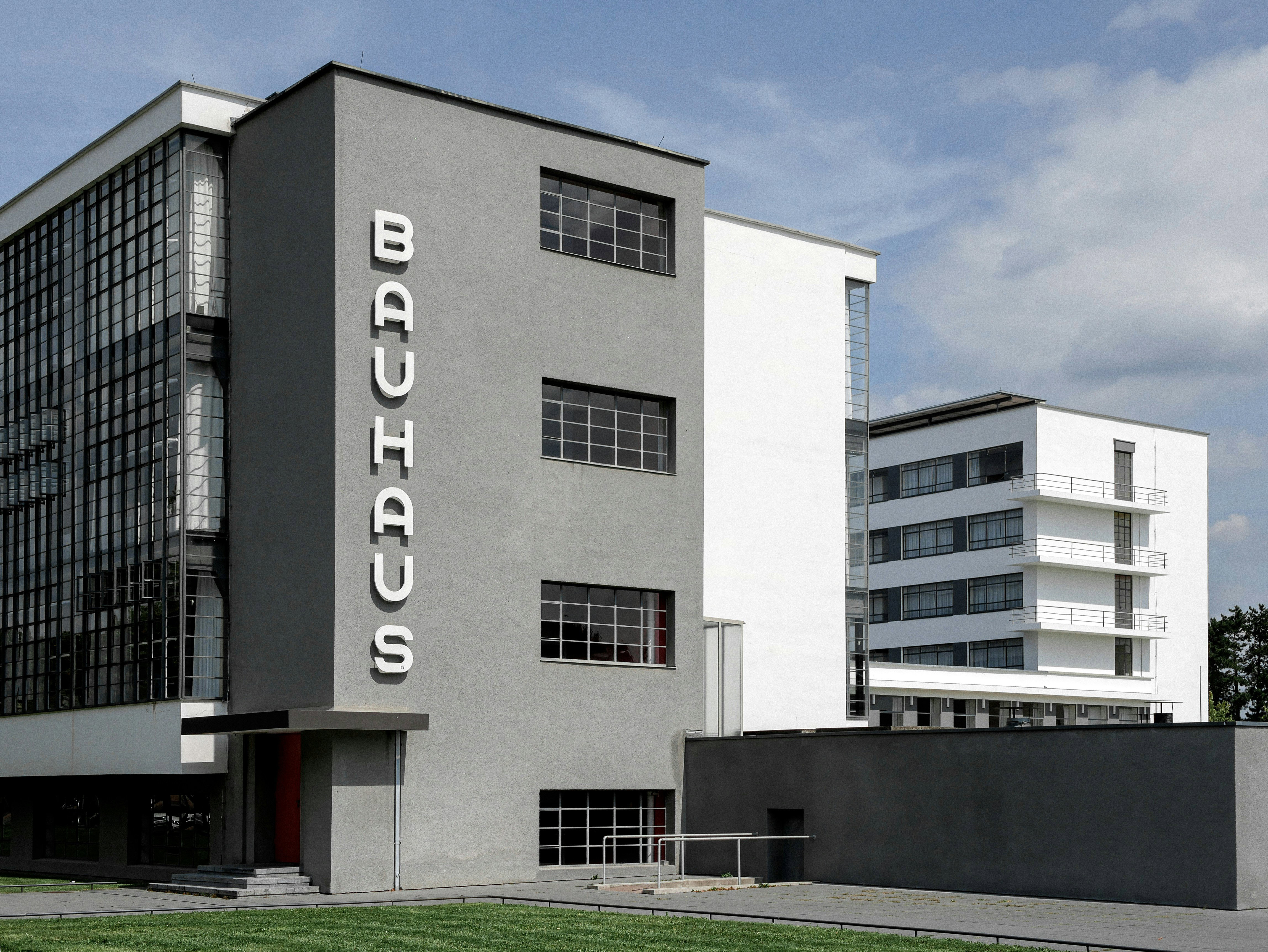
Dessau is where Gropius had his chance to build. The school building he designed there is flooded with light. You can walk through the workshops and know exactly what was made where. Stay long enough and you can watch the external light ebb and flow through the building. That, for me, is nearly metaphysical. We also walk to the Masters’ Houses – where the professors lived — and into the studio of Kandinsky. To stand in the space where he made his abstractions is extraordinary.
In Berlin, one building encapsulates the entire history of the Bauhaus: the Neue Nationalgalerie, Mies van der Rohe’s final building. Van der Rohe was the third and last director; he moved the school to Berlin for its final nine months after funding was cut in Dessau, and the Nazis closed it in 1933. That building proclaims everything the Bauhaus had stood for: a new design for a new nation, a new way of being.
Your other tour, Building Modern Germany takes that story forward into the post-war decades and the present. What does Germany offer that no other country can?
No European country has, in the last hundred years, experienced a comparable degree of turbulence and reversal of fortune – nor seen the same intensity of innovation, reaction, destruction and renewal. Germany is always in a moment of reckoning, and that reckoning is communicated visually, through architecture.
In Stuttgart we visit the Weißenhofsiedlung – the 1927 housing exhibition in which van der Rohe, two years before becoming Bauhaus director, invited architects from across the world to create built manifestations of their principles. Its centenary falls in 2027, the very year of the tour. In Ulm, the Hochschule für Gestaltung, founded in 1953 and directly descended from the Bauhaus in its ambitions, extended those ideas into what we would now call media design – the design of information and communication. Everything we interact with visually in daily life has a lineage that passes through Ulm.
Munich is the most complex stop. The NS-Dokumentationszentrum stands on the exact site of the Brown House, the Nazi Party headquarters – a building of remarkable restraint and intelligence placed in direct confrontation with the Führerbau opposite. Elsewhere the Olympic complex of 1972, designed by Frei Otto, literally rose from mounds of wartime rubble, its great tent roof one of the defining architectural gestures of the century.

A house in the Weißenhofsiedlung ©Dietmar Rauscher
You’ve been leading tours for Martin Randall Travel for 26 years. What has kept you coming back?
Every day on tour I know what we are going to see – but I never know what will be new in that space for me. That is what gives me the energy. I wake up each morning and ask the question: what will we discover today? That question never loses its force.
I also think the tours have grown with me. When I look at the programmes I lead that relate to the modern – from Frank Lloyd Wright and the American Modern, through the Bauhaus, through Building Modern Germany – I see a coherent arc that has developed in a very organic way. I’m not certain Martin planned it that way. But it has worked out beautifully.
Is there a single question that unites all of this?
Yes – of every place we visit, I want to ask: does this change the way we live today? When the answer is yes, and on these tours it almost always is, then the experience of being in that space with a group of people discovering it together becomes something quite rare. I have the great luck of being able to communicate my love of beauty, and by doing so I hope to create not just sightseeing, but a joy of discovery – and perhaps inspiration.
Meet the expert
Tom Abbott's tours for 2026-7

Sign up to our e-newsletter
e-newsletter recipients are the first to hear about our future plans and our tours as they come on sale. By signing up you agree to our Privacy policy.




My Wishlist
Please note that all saved tours will be removed if you clear your cookies.