
Europe
(171)
Italy
(59)
France
(21)
Germany
(21)
United Kingdom
(17)
Spain
(16)
Austria
(8)
Czech Republic
(6)
Greece
(5)
Switzerland
(4)
Finland
(3)
Netherlands
(3)
Portugal
(3)
Belgium
(2)
Malta
(2)
Slovakia
(2)
Albania
(1)
Bulgaria
(1)
Croatia
(1)
Cyprus
(1)
Denmark
(1)
Hungary
(1)
Ireland
(1)
Norway
(1)
Poland
(1)
Romania
(1)
Slovenia
(1)
Sweden
(1)
    Array
(
    [0] => Array
        (
            [name] => Czech Republic
            [category] => Array
                (
                    [name] => Country
                )

            [parent] => Array
                (
                    [name] => Europe
                )

        )

)


Treasures of Moravia - Great houses and gardens in the heart of Europe
8
days
from
£4,020
Book today with a deposit from
£603
28th May 2027 - 4th June 2027
Tour highlights
- Unspoilt historic towns, Renaissance châteaux, and some of the most extraordinary Baroque palaces and churches in Central Europe.
- A little-known region with a fascinating architectural patrimony and enchanting landscapes.
- Several UNESCO World Heritage sites, including Mies van der Rohe’s Villa Tugendhat, and newly restored châteaux and gardens.
For a brief but significant period in the ninth century the Great Moravian Empire encompassed not only Czech and Slovak lands but also parts of what are now Austria, Hungary and Poland. This agglomeration of territories proved short-lived, and as Moravia declined, neighbouring Bohemia began to take shape and thereafter dominated the historic partnership of the Czech lands.
Politically overshadowed though it often was, Moravia prospered. From 1526 until the creation of Czechoslovakia in 1918 it formed part of the Habsburg dominions, benefiting from its proximity to Vienna, the chief metropolis of Central Europe. The result is a remarkably rich architectural inheritance: fine Renaissance country houses; outstanding Baroque palaces and churches; the bizarre creations of Jan Santini-Aichel; gardens both formal and landscaped; distinguished collections of fine and decorative art; and much beautiful streetscape in towns and villages. The rolling landscape and craggy hills of South Moravia, long associated with viticulture, are also known for producing the finest wines in the Czech Republic.
Yet despite its artistic distinction and scenic charm, Moravia remains markedly less visited than Bohemia. Architectural conservation proceeds apace, hotels and restaurants are improving, and more and more museums and historic buildings are refurbished and restored to their former glory. Even so, Moravia retains an air of authenticity and tranquillity that is increasingly rare in Europe.
Itinerary
Fly mid-morning from London Heathrow to Prague and drive south into Moravia. First of two nights in Třešť.
Perched high above a gorge close to the Austrian border, the great oval Hall of Ancestors (1688) at Vranov is one of the most impressive Baroque creations in Central Europe, the work of the greatest architect and painter in the region at the time, Fischer von Erlach. The Renaissance chateau in Uherčice, recently restored after decades of neglect during the Communist era, features unique stucco decoration in its Oval Hall, created by Baldassare Fontana. The grand Banquet Hall, famed for its impressive acoustics and excellent wall paintings, is among the most impressive secular interiors in Moravia.
Telč is a tiny town with the loveliest square in the Czech Lands, lined with Renaissance and Baroque façades above a meandering Gothic arcade. The castle here was extended in stages during the 16th century with a series of halls of brilliant, eccentric decoration around elegant, arcaded courtyards; a jewel of the Northern Renaissance. Further south, on a vast estate straddling the Austrian border once owned by the Liechtensteins – the richest magnates in the Habsburg Empire – Lednice has a superbly crafted Gothic Revival mansion, magnificent Baroque stables by Fischer von Erlach and a landscaped park dotted with architectural follies. Overnight in Lednice.
Valtice, the wine capital of Moravia, is also home to perhaps the grandest of the Baroque country houses in the Czech lands, serving as the main seat of the Liechtensteins until 1945. The palace contains one of the most sumptuous interiors in Moravia – a unique chapel by Antonio Beduzzi (1726). Visit also the marble-lined Spanish stables, the vast Winter Riding Hall and the painstakingly accurate reconstruction of an 18th-century theatre complete with authentic stage machinery. Continue to Brno, the second largest Czech city and present capital of Moravia. First of four nights in Brno.
Morning visit to Villa Tugendhat (subject to final confirmation), a superb house by modernist architects Ludwig Mies van der Rohe and Lilly Reich. Free afternoon or an optional walk through the core of Brno. One of the loveliest and most interesting cities in the former Habsburg Empire, Brno is a showcase for historic buildings of many centuries and scene of a rich cultural life.
Bučovice has a splendid Renaissance mansion with an arcaded courtyard and stucco interiors of a quality virtually without equal in northern Europe. At nearby Buchlovice, a charming Italianate Baroque villa, a magnificent domed two-storey hall is adorned with superb stucco by Baldassare Fontana. The house is complemented by a formal garden and an extensive landscaped park containing rare tree species from North America and Asia.
First documented in 1285, the Gothic-Renaissance Pernštejn Castle stands as one of the best-preserved medieval castles in the Czech Republic. Visit the entrance hall with its remarkable diamond vault, the Knights’ Hall, and the newly restored terraced garden dating back to the early 19th century. The chateau at Lysice combines a Baroque exterior with primarily 19th-century interiors, including a Neo-Renaissance library. The chateau garden, which reopened in 2024 after extensive renovation, has an orangery, a historic fighouse with an 1880s sliding roof, and a spectacular garden colonnade.
Drive to the pilgrimage church of St John Nepomuk (1722), a Baroque-Gothic creation by the maverick architect Santini-Aichel and among the most bizarre and fascinating buildings of the 18th century. Continue to Prague for the flight to Heathrow, arriving early evening.
A number of the visits are by special arrangement. It is possible the order of visits may vary from the description above.
Expert speaker
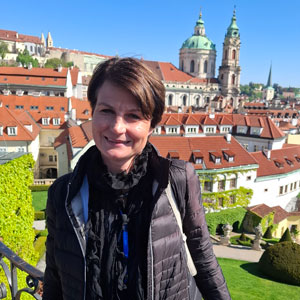
Martina Hinks-Edwards
Martina Hinks-Edwards studied English at Charles University, Prague. She began working for MRT while still studying, firstly as an interpreter for groups visiting the Czech Republic, and from 2004 as a tour leader with a wide breadth of knowledge of the country’s cultural history. She has led tours throughout the Czech Republic and has a particular interest in 20th-century Czech history and architecture. The countless accolades she has received over the years from her clients, is a reflection of her energy and enthusiasm for the job.
Practicalities
Two sharing: £4,320 or £4,020 without flights. Single occupancy: £4,700 or £4,440 without flights.
Travel by private coach; accommodation as described below; breakfasts, 6 lunches and 5 dinners with wine, water, coffee; all admissions; all tips; all taxes; the services of the lecturer and local tour manager.
Chateau Hotel, Třešť: an adequate and well-located conference hotel set in a converted chateau. Hotel Galant, Lednice: a 4-star hotel conveniently situated next to Lednice Castle. Décor and furnishings are dated but adequate. Hotel Grandezza, Brno: a 5-star hotel located in the heart of Brno’s historic centre, The Cabbage Market. Single rooms are doubles for sole use.
There is quite a lot of walking on this tour, some of it up slopes or up steps. To be able to enjoy the tour it would be essential to manage daily walking and stair-climbing without any difficulties. There is also a fair amount of driving. Average distance by coach per day: 82 miles.
Between 10 and 24 participants
Before booking, please refer to the FCDO website and Travel Health Pro to ensure you are happy with the travel advice for the destination(s) you are visiting.
Dates & prices
                GBP                Array
(
    [0] => Array
        (
            [id] => 01kjds3hvqnx6sjhdzacz2eepr
            [published] => 1
            [start] => 2027-05-28 00:00:00
            [end] => 2027-06-04 00:00:00
            [range_type] => Fixed
            [version] => Array
                (
                    [id] => 01kjdd5sy6fhzecbkvn1kt9205
                    [name] => 2027
                )

            [inventory] => Array
                (
                    [type] => Allocation
                    [capacity] => 22
                    [errata] =>
                )

            [categories] => Array
                (
                    [0] => Array
                        (
                            [name] => Ms Martina Hinks-Edwards
                            [description] =>
                        )

                )

            [fields] => Array
                (
                    [0] => Array
                        (
                            [__typename] => StringFieldData
                            [name] => tb_departure_setup_id
                            [string] => 29794
                        )

                    [1] => Array
                        (
                            [__typename] => StringFieldData
                            [name] => tb_link_speakers
                            [string] => [{"id":34302,"title":"Ms","forename":"Martina","surname":"Hinks-Edwards","type":"Lecturer"}]
                        )

                    [2] => Array
                        (
                            [__typename] => StringFieldData
                            [name] => tb_departure_code
                            [string] => MN382
                        )

                    [3] => Array
                        (
                            [__typename] => StringFieldData
                            [name] => onlinetalk_booking_link
                            [string] =>
                        )

                )

            [elements] => Array
                (
                    [0] => Array
                        (
                            [id] => 01kjds3hwg8jnmf0jwg95ntgj7
                            [element] => Array
                                (
                                    [id] => 01kjds3hk1h4vv23chxnbw6ne1
                                    [category] => Array
                                        (
                                            [name] => Tour Space
                                        )

                                    [name] => Tour Space
                                    [published] => 1
                                    [is_package] => 1
                                )

                            [prices] => Array
                                (
                                    [0] => Array
                                        (
                                            [id] => 01kjds3hx5wbrk58kk94pc7jhw
                                            [currency] => GBP
                                            [value] => 4020
                                            [on_sale] => 1
                                            [previous_value] =>
                                            [deposit] =>
                                            [option] => Array
                                                (
                                                    [id] => 01kjds3hnfha2g8p15kytp4qtt
                                                    [name] => Tour Space
                                                    [category] => Array
                                                        (
                                                            [name] => Price
                                                        )

                                                    [constraints] =>
                                                    [web_bookable] => 1
                                                    [published] => 1
                                                )

                                        )

                                )

                        )

                    [1] => Array
                        (
                            [id] => 01kjds3hxdhdpv0jspvwa7sxrw
                            [element] => Array
                                (
                                    [id] => 01kjds3hqsqqyt41zz64p0x62v
                                    [category] => Array
                                        (
                                            [name] => Flights
                                        )

                                    [name] => Flight
                                    [published] => 1
                                    [is_package] => 1
                                )

                            [prices] => Array
                                (
                                    [0] => Array
                                        (
                                            [id] => 01kjds3hy21dsd87qb0at3r08q
                                            [currency] => GBP
                                            [value] => 900
                                            [on_sale] => 1
                                            [previous_value] =>
                                            [deposit] =>
                                            [option] => Array
                                                (
                                                    [id] => 01kjds3hsynyaczz3sjy1khb8z
                                                    [name] => Price
                                                    [category] => Array
                                                        (
                                                            [name] => Price
                                                        )

                                                    [constraints] =>
                                                    [web_bookable] => 1
                                                    [published] => 1
                                                )

                                        )

                                )

                        )

                )

        )

)
2027
Date
Speaker
Price
Date:
28th May - 4th June 2027
Speaker:
Martina Hinks-Edwards
Price:
from £4,020
(Based on two sharing)Related tours and events


Sign up to our e-newsletter
e-newsletter recipients are the first to hear about our future plans and our tours as they come on sale. By signing up you agree to our Privacy policy.




My Wishlist
Please note that all saved tours will be removed if you clear your cookies.
Sign up to our e-newsletter
E-newsletter recipients are the first to hear about our future plans and our tours as they come on sale.